
The Historical Significance of Rainbow Bridge in Relation to Niagara Falls
Introduction
The Rainbow Bridge is the steel arch that carries cars and pedestrians across the Niagara Gorge between Niagara Falls, Ontario and Niagara Falls, New York, just downstream from the falls themselves. It opened in 1941 to replace the collapsed Honeymoon Bridge and has since become one of the most recognizable border crossings in North America. The sections below trace the crossings that came before it, how it was built, and the role it plays for the two cities that share the falls.
Historical Context
The region around Niagara Falls has long been home to Indigenous peoples, including the nations of the Haudenosaunee (Iroquois) Confederacy. Europeans began exploring the area in the 17th century, and by the 18th century, British and French tensions over control of the region escalated. The Treaty of Paris in 1763 firmly established British control, leading to increased settlement and the eventual growth of the modern cities of Niagara Falls in both Ontario, Canada, and New York, United States.
Early Crossings
Long before the Rainbow Bridge, travellers crossed the Niagara River by ferry, and the first bridges over the gorge were suspension spans built downstream of the falls in the mid-1800s. Nearer the falls, the Upper Steel Arch Bridge — better known as the Honeymoon Bridge — opened in 1897 and held the record as the world’s longest steel arch bridge for nearly two decades, until 1916. On January 27, 1938, an ice jam in the gorge crushed its low abutments and the span dropped onto the frozen river below, leaving the two cities without a direct link at the falls.
Rainbow Bridge Construction
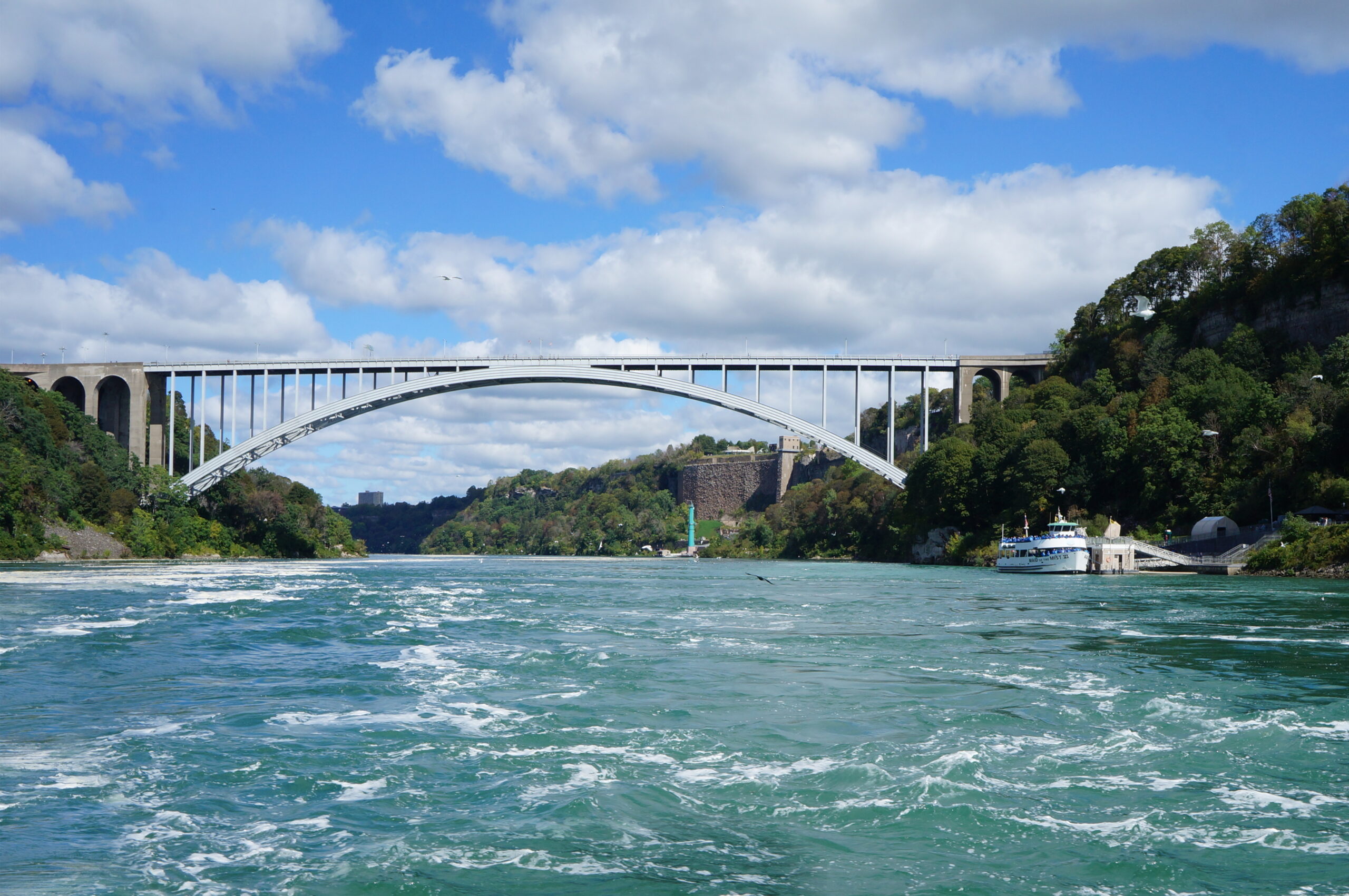
Work on the Rainbow Bridge began in May 1940, built to take the place of the lost Honeymoon Bridge. It was designed by architect Richard Lee, with the engineering carried out by Edward P. Lupfer’s Buffalo firm. The Niagara Falls Bridge Commission had chosen the name in 1939 for the rainbows that form in the mist rising off the falls nearby. The finished crossing serves both pedestrian and vehicle traffic, its single steel arch spanning about 290 metres (roughly 950 feet) between the two Niagara Falls cities.
Architecture and Design
The Rainbow Bridge is a single steel arch that springs from the walls of the gorge, leaving no piers in the river below. That clean, uninterrupted span gives people crossing the border an open view of the Niagara Gorge and the falls upstream, and its simple silhouette has made it one of the region’s most photographed landmarks.
Official Opening and Significance
The Rainbow Bridge opened to traffic on November 1, 1941. Replacing the Honeymoon Bridge restored the direct connection between the two Niagara Falls cities and made it easier for visitors to cross the border and see the falls from both sides. It remains a busy crossing, handling millions of vehicles and pedestrians each year.
The Global Impact of Rainbow Bridge
Today the Rainbow Bridge is closely tied to the identity of both Niagara Falls cities. Its open arch and its position beside the falls make it a favourite spot for photographs, and it stands as a practical symbol of the long-standing ties between Canada and the United States.
Conclusion
For visitors, the Rainbow Bridge is more than a piece of history — it is the most convenient way to move between the Canadian and American sides on foot or by car, letting you take in the falls from both countries in a single day. If you plan to walk or drive across, check current toll rates, hours, and the border-crossing documentation you will need before you go.