
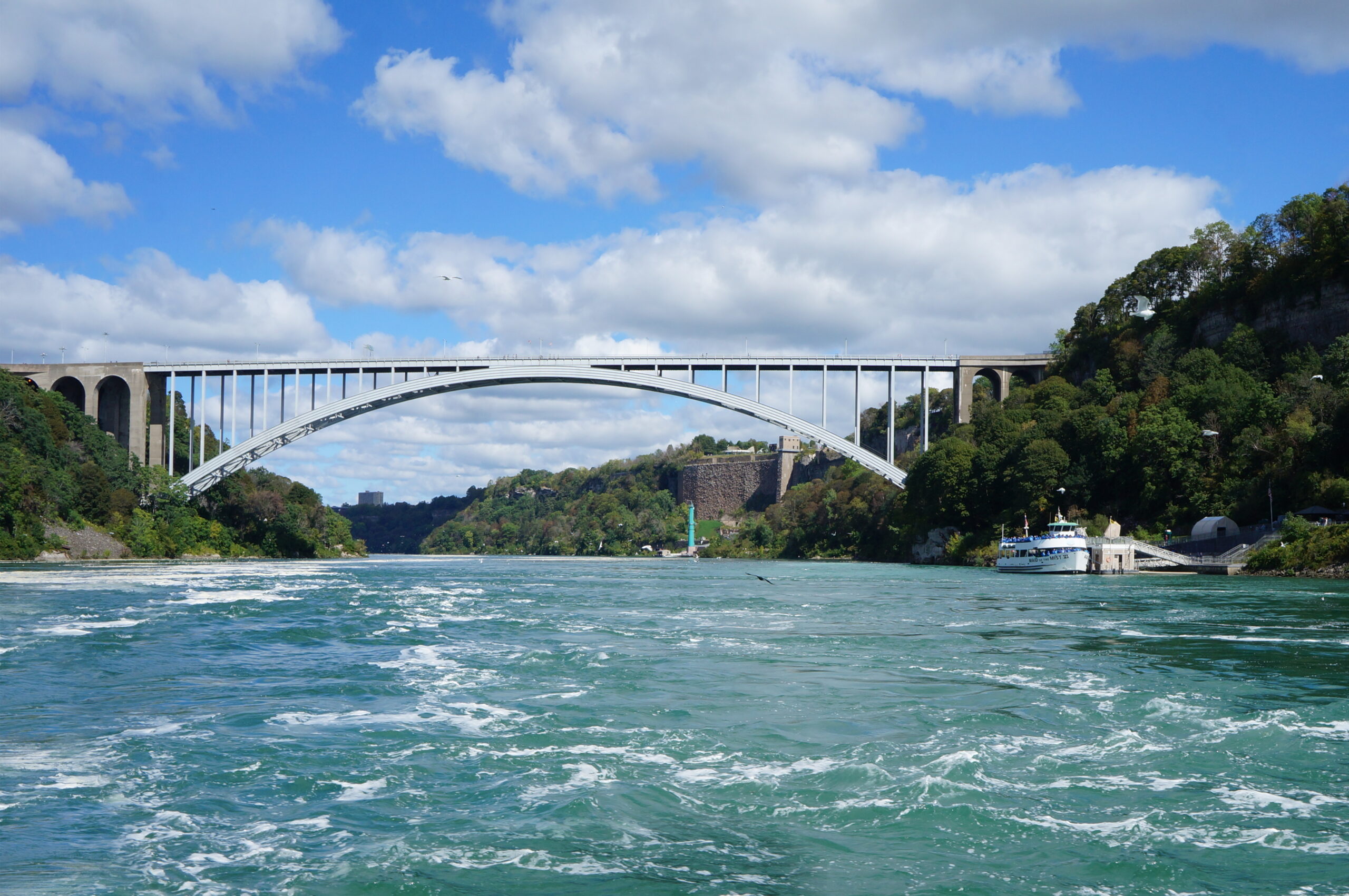
The Niagara River carries one of the busiest stretches of the Canada-United States border, and four international bridges link Ontario and New York along it. Each crossing serves a slightly different purpose, so knowing which bridge to aim for, and what to have ready when you reach the booth, makes the trip far smoother whether you are day-tripping to Buffalo or coming over to see the falls from the Canadian side. This guide walks through the four bridges, the documents you'll need in each direction, the NEXUS trusted-traveller program, and a few practical tips for timing your crossing. Border rules, hours, and fees change, so always confirm the details with the official US and Canadian agencies and bridge operators before you travel.
| Crossing | General | NEXUS |
|---|---|---|
| Peace Bridge | 7 min | 1 min |
| Rainbow Bridge | 9 min | — |
| Whirlpool Bridge | NEXUS only | — |
| Lewiston-Queenston Bridge | 0 min | — |
The four bridges and what each connects
Four international bridges span the Niagara River in this corridor. Three of them, the Rainbow, Whirlpool Rapids, and Queenston-Lewiston bridges, are operated by the Niagara Falls Bridge Commission, while the Peace Bridge to the south is run by the separate Buffalo and Fort Erie Public Bridge Authority. They differ in where they land, what kinds of vehicles they allow, and how close they sit to the falls, so it pays to pick the right one before you set out.
Peace Bridge (Fort Erie to Buffalo)
The southernmost of the four crossings, the Peace Bridge links Fort Erie, Ontario with Buffalo, New York, connecting the Queen Elizabeth Way on the Canadian side to the Interstate highway network around Buffalo. It sits upriver near the outlet of Lake Erie, some distance from the falls, and carries the full range of traffic, including passenger cars, buses, and commercial trucks. That makes it a natural choice if you are heading to or from the Buffalo area or travelling farther afield rather than visiting the falls themselves.
Rainbow Bridge (Niagara Falls, Ontario to Niagara Falls, New York)
The Rainbow Bridge sits closest to the falls and lands right in the heart of the tourist districts on both sides, making it the go-to crossing for sightseers. It is open to passenger vehicles, buses, recreational vehicles, cyclists, and pedestrians, but commercial trucks are not permitted. If you want to walk across for the view or drive over to explore the attractions on the opposite bank, this is the bridge to use.
Whirlpool Rapids Bridge (NEXUS members only)
A short distance downstream (north) of the Rainbow Bridge, the Whirlpool Rapids Bridge connects the two Niagara Falls cities but is reserved for NEXUS trusted-traveller members. Every person in the vehicle must hold a valid NEXUS card to use it, which keeps traffic light and crossings quick for those who qualify. A separate deck above the roadway carries cross-border passenger rail service. If you are not a NEXUS member, you cannot use this crossing and should choose one of the others.
Queenston-Lewiston Bridge (Niagara-on-the-Lake area to Lewiston, New York)
The northernmost of the Niagara Falls Bridge Commission crossings, the Queenston-Lewiston Bridge (officially the Lewiston-Queenston Bridge) links Queenston, in the Niagara-on-the-Lake area of Ontario, with Lewiston, New York. It connects to major highways on both sides and is open to all vehicle types, including commercial trucks, though not to pedestrians, so it is the crossing of choice for larger vehicles and for travellers coming from or heading to wine country and the northern part of the region.
Travel documents you'll need
You must present proof of identity and citizenship every time you cross, in either direction, and requirements differ slightly depending on which way you are going and your citizenship. A valid passport is the most widely accepted document and is the safest thing to carry, but there are alternatives for land crossings. Because rules vary by citizenship and change over time, confirm what applies to you with US Customs and Border Protection and the Canada Border Services Agency before you travel, especially if you are not a US or Canadian citizen.
- Passport: A valid passport is accepted for all travellers in both directions and is the recommended document to carry, regardless of age.
- Enhanced driver's licence: US and Canadian citizens can use an enhanced driver's licence (EDL) at a land crossing in place of a passport. Only certain states and provinces issue them, so check that yours qualifies.
- NEXUS card: A valid NEXUS card is an accepted document at land crossings and is required to use the Whirlpool Rapids Bridge. Carrying your passport as well is still a good idea.
- Children under 16: US and Canadian citizen children under 16 can generally cross by land with a birth certificate (original, photocopy, or certified copy) or other proof of citizenship, rather than a passport.
- Children under 19 in supervised groups: US and Canadian citizen children under 19 arriving by land with a school, religious, cultural, or sports group may present a birth certificate or other proof of citizenship, provided the group carries the required documentation.
- Minors travelling without both parents or guardians: Carry a consent or authorization letter from the absent parent(s) or guardian(s) giving permission for the trip, along with the child's proof of citizenship.
The NEXUS trusted-traveller program
NEXUS is a joint program run by the Canada Border Services Agency and US Customs and Border Protection that gives pre-approved, low-risk travellers faster processing at the border. Members use dedicated NEXUS lanes at land crossings, which are typically much quicker than the regular queues, and the Whirlpool Rapids Bridge is reserved for their use. To join, you apply online through the Trusted Traveler Programs system, pass a background check by both countries, and attend an interview. A non-refundable application fee applies (costs apply, see the official source for the current amount), and membership lasts five years before it needs to be renewed. For frequent border-crossers, it can turn a long wait into a few minutes, but remember that everyone in the vehicle must be a member to use a NEXUS lane or the Whirlpool Rapids Bridge.
Practical tips for a smooth crossing
A little planning goes a long way at the border. Wait times can swing from a few minutes to well over an hour depending on the day and the bridge, so timing and preparation matter as much as picking the right crossing.
- Check live wait times before you go. The Niagara Falls Bridge Commission and the US and Canadian border agencies publish current conditions for each bridge, so you can compare and choose the shortest line.
- Avoid peak periods when you can. Weekend afternoons, holidays, and long-weekend returns are the busiest times; mid-week and early-morning crossings are usually far quicker.
- Have your documents ready before you reach the booth. Everyone in the vehicle should have their identification out and be prepared to answer the officer's questions.
- Budget for tolls. Each bridge charges a toll, generally collected in the direction entering Canada, and rates and accepted payment methods can change. Costs apply, so check the official bridge operator's site for current amounts before you cross.
- Consider NEXUS if you cross often. Members get dedicated lanes and exclusive use of the Whirlpool Rapids Bridge, which can save significant time at busy crossings.
- Match the bridge to your vehicle and destination. Use the Rainbow Bridge for the falls, the Peace Bridge for Buffalo, and the Queenston-Lewiston Bridge for larger vehicles or the northern part of the region.
Sources: www.niagarafallsbridges.com · www.niagarafallsbridges.com · www.peacebridge.com · www.cbp.gov · www.cbsa-asfc.gc.ca. Last reviewed 2026-07-18.
Bridge wait times into the U.S. are shown live, alongside current weather on both sides of the river, on our Niagara Falls conditions page.