
Short answer: for almost everyone, yes – you need a passport, or an approved equivalent, to cross the border at Niagara Falls. A valid passport book is the one document that works for every traveller, in every direction, by land, sea and air. It is the safe default. That said, a passport book is not the only accepted document at the land crossings, and children get an easier ride. This guide sets out exactly what each type of traveller needs, verified against official US and Canadian government sources on 24 July 2026, and flags the traps that catch real people every week.
The quick answer, by traveller type
Niagara’s crossings are land borders (bridges). That matters, because land and sea crossings follow slightly more relaxed document rules than airports do. Here is who needs what to cross by land at Niagara. Confirm the details in the sections below before you travel.
| Traveller | Minimum document to cross by land | Notes |
|---|---|---|
| US or Canadian citizen, 16+ | Passport book, OR passport card, OR Enhanced Driver’s Licence (EDL), OR NEXUS/SENTRI/FAST card | Must prove both identity AND citizenship |
| US or Canadian citizen child, under 16 | Proof of citizenship (e.g. birth certificate) accepted by land | Passport still recommended; required if the child flies |
| Visa Waiver Program national (UK, most of the EU, Japan, Australia, etc.) | Passport plus an approved ESTA | ESTA is required even at a land crossing – a common surprise |
| Other foreign visitor | Passport, plus a visa if required | Check requirements for your nationality before travelling |
| US lawful permanent resident | Permanent Resident Card (Green Card, Form I-551) | Unaffected by the passport rules below |
The single biggest trap: the passport card and the Enhanced Driver’s Licence are valid only for land and sea crossings. If any part of your trip could end with you flying back into the United States – a change of plans, a weather diversion, a missed drive home – you need a passport book. Do not leave home with only a passport card or EDL if there is any chance you will fly. This one catches people every year.
Entering (or re-entering) the United States: the WHTI land rules
Since 1 June 2009, the Western Hemisphere Travel Initiative (WHTI) has governed how US and Canadian citizens enter the United States by land or sea. The rule is simple to state: everyone aged 16 and over must present a single document, or an accepted combination, that proves both identity and citizenship. Verbally claiming to be a citizen is not enough.
For US citizens crossing into the US by land at Niagara, US Customs and Border Protection (CBP) accepts:
- US passport book – works everywhere, land, sea and air
- US passport card – land and sea only, not valid for international air travel
- Enhanced Driver’s Licence (EDL) or Enhanced ID – land and sea only
- Trusted Traveler card – NEXUS, SENTRI or FAST
- US military ID (on official orders) or Merchant Mariner Document (on official maritime business)
- Form I-872 American Indian Card or an Enhanced Tribal Card, where issued
For Canadian citizens entering the US by land, CBP accepts a valid Canadian passport, an Enhanced Driver’s Licence, or a Trusted Traveler card (NEXUS/SENTRI/FAST). US lawful permanent residents present their Green Card (Form I-551) and are not subject to WHTI. Bermudian citizens need a passport; Mexican citizens, including children, need a passport with a visa or a Border Crossing Card.
Passport book vs passport card vs EDL
These three trip people up, so here is the plain-English difference:
- Passport book – the gold standard. Works by land, sea and air, into and out of both countries. If you own only one travel document, make it this.
- Passport card – a wallet-sized card that proves US citizenship and identity for entry from Canada, Mexico, the Caribbean and Bermuda by land or sea only. It is cheaper than the book but cannot be used for international flights. It also counts as a REAL ID for domestic US flights.
- Enhanced Driver’s Licence (EDL) – a driver’s licence that also proves citizenship, marked with a US flag and the word “Enhanced.” In the US, only five states issue them: Michigan, Minnesota, New York, Vermont and Washington. Like the passport card, an EDL is valid for land and sea crossings but not for international air travel.
On the Canadian side, several provinces (including Ontario) once issued Enhanced Driver’s Licences but have since stopped issuing new ones; existing valid cards may still be accepted until they expire. If you are a Canadian relying on a provincial EDL, check current status with your province’s licensing authority before you travel – we were unable to confirm each province’s current issuance against an official provincial source, and this is exactly the kind of detail that changes.
Crossing with children
The rules are gentler for minors. US and Canadian citizen children under 16 need only present proof of citizenship – typically an original or a copy of a birth certificate, or a naturalization/citizenship certificate – when entering the US by land or sea. No passport is required under WHTI. Children under 19 travelling with a school, religious, cultural or sports group under adult supervision get the same treatment.
Two important caveats. First, a birth certificate gets a child across the bridge but does not work if the child ends up flying – so a passport is still the smoother, safer choice. Second, if a child is travelling without both parents or guardians, the Canada Border Services Agency (CBSA) strongly recommends carrying a notarized consent letter from the non-accompanying parent(s), and officers may ask for custody documents. The US State Department gives the same advice. It is a recommendation rather than a strict statutory requirement, but border officers can and do ask, and a missing letter can turn a five-minute crossing into a long one. If you are a separated or single parent, or a grandparent travelling with grandchildren, prepare the letter in advance.

Entering Canada: what CBSA expects
Coming the other way, US citizens do not need a visa or an electronic travel authorisation (eTA) to visit Canada, and can generally stay for up to six months. As with the US side, everyone must prove citizenship and identity at the border.
CBSA’s clear recommendation is that a valid passport is the only universally accepted document. For US citizens specifically, CBSA also accepts a US passport card, a NEXUS card, or an Enhanced Driver’s Licence, and will accept a combination of documents (for example, a birth certificate to prove citizenship plus a government-issued photo ID to prove identity). But “a combination might be accepted” is a weaker position to be in than “here is my passport.” The friction-free option in both directions is a passport book.
US lawful permanent residents entering Canada by land present their US Green Card. Foreign (non-US) visitors who are visa-exempt normally need an eTA to fly to Canada, but an eTA is not required for land arrivals – if you drive or walk into Canada at Niagara, you still need a valid passport and, where applicable, a visa, but not an eTA.
Visa Waiver Program travellers need an ESTA – even by land
This is the confusion that trips up international visitors most often, so read it carefully. If you are a national of a Visa Waiver Program (VWP) country – the United Kingdom, most of the European Union, Japan, Australia, New Zealand, South Korea and others – you may believe an ESTA (Electronic System for Travel Authorization) is “only for flights.” That has not been true since 1 October 2022.
Since that date, CBP has required all VWP travellers to hold an approved ESTA before applying for admission at a land port of entry, exactly as at an airport. So a British, German or Japanese visitor who spends a few days in Toronto and then drives or walks across at Niagara into the United States must have a valid ESTA. Apply only at the official site, esta.cbp.dhs.gov – there are many lookalike third-party sites that charge extra. As of early 2026 the ESTA fee is reported to be about US$40 (up from US$21 in 2022), but fees change; confirm the exact current amount on the official site when you apply.
Do not leave it to the last minute. ESTA approval can take up to 72 hours, so it is not something to arrange in the queue. If you reach a US land port without a valid ESTA, you may be permitted to withdraw your application for admission, return to Canada, apply, and come back once approved – but that is a wasted day you can easily avoid by applying before you leave home.
Do you still need ArriveCAN? No.
You do not need ArriveCAN to drive or walk across the border at Niagara. The mandatory, COVID-era public-health use of the ArriveCAN app ended on 1 October 2022. What survives is an optional “Advance Declaration” feature that lets air travellers submit their customs and immigration declaration up to 72 hours before landing at participating Canadian airports, to save time at the kiosk. It is optional, it is an airport time-saver, and it has no bearing on a land crossing. For your Niagara bridge trip, you can ignore it entirely.
The four Niagara-area border crossings
There are four bridges to choose from in the Niagara area. Three are run by the Niagara Falls Bridge Commission (NFBC); the fourth, the Peace Bridge, is run by the bi-national Buffalo and Fort Erie Public Bridge Authority. Which one you want depends on where you are going and whether you are on foot.
| Crossing | Connects | Who can use it | Best for |
|---|---|---|---|
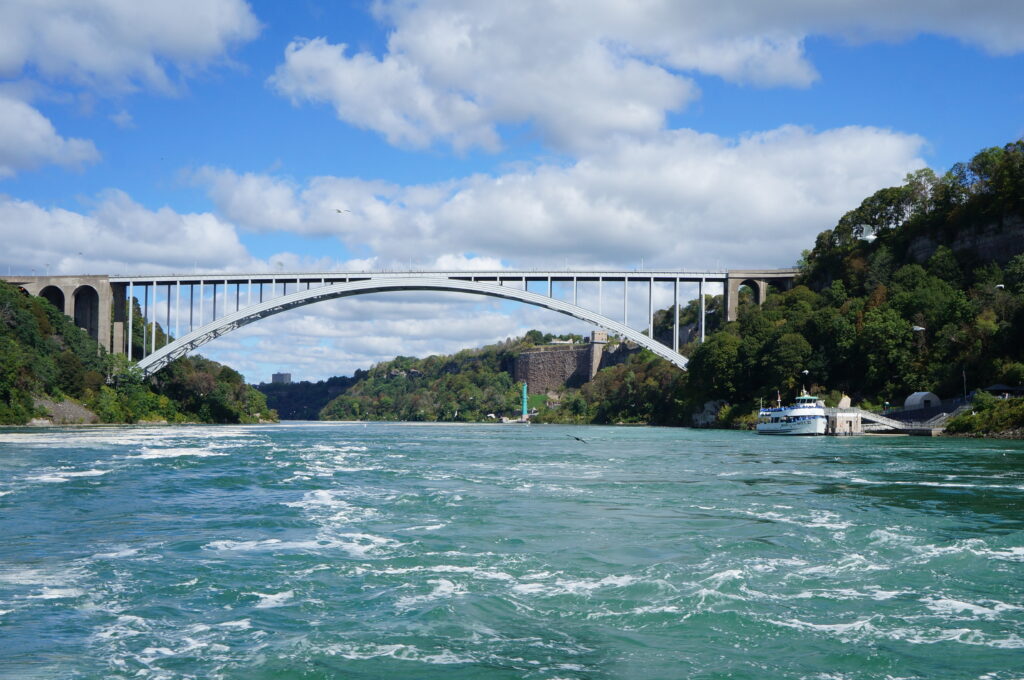
| Rainbow Bridge | Niagara Falls, NY ↔ Niagara Falls, ON | Cars, RVs, buses, limos, bicycles and pedestrians; no commercial trucks | Tourists – closest to the Falls and both tourist districts; the only walkable crossing |
| Whirlpool Rapids Bridge | Niagara Falls, NY ↔ Niagara Falls, ON | NEXUS cardholders only; cars only; no trucks, pedestrians or bicycles | NEXUS members wanting the fastest crossing (subject to construction closures) |
| Lewiston-Queenston Bridge | Lewiston, NY ↔ Queenston, ON | Cars, RVs, buses, limos, bicycles and commercial trucks; no pedestrians | Through-traffic and avoiding downtown congestion; has NEXUS lanes |
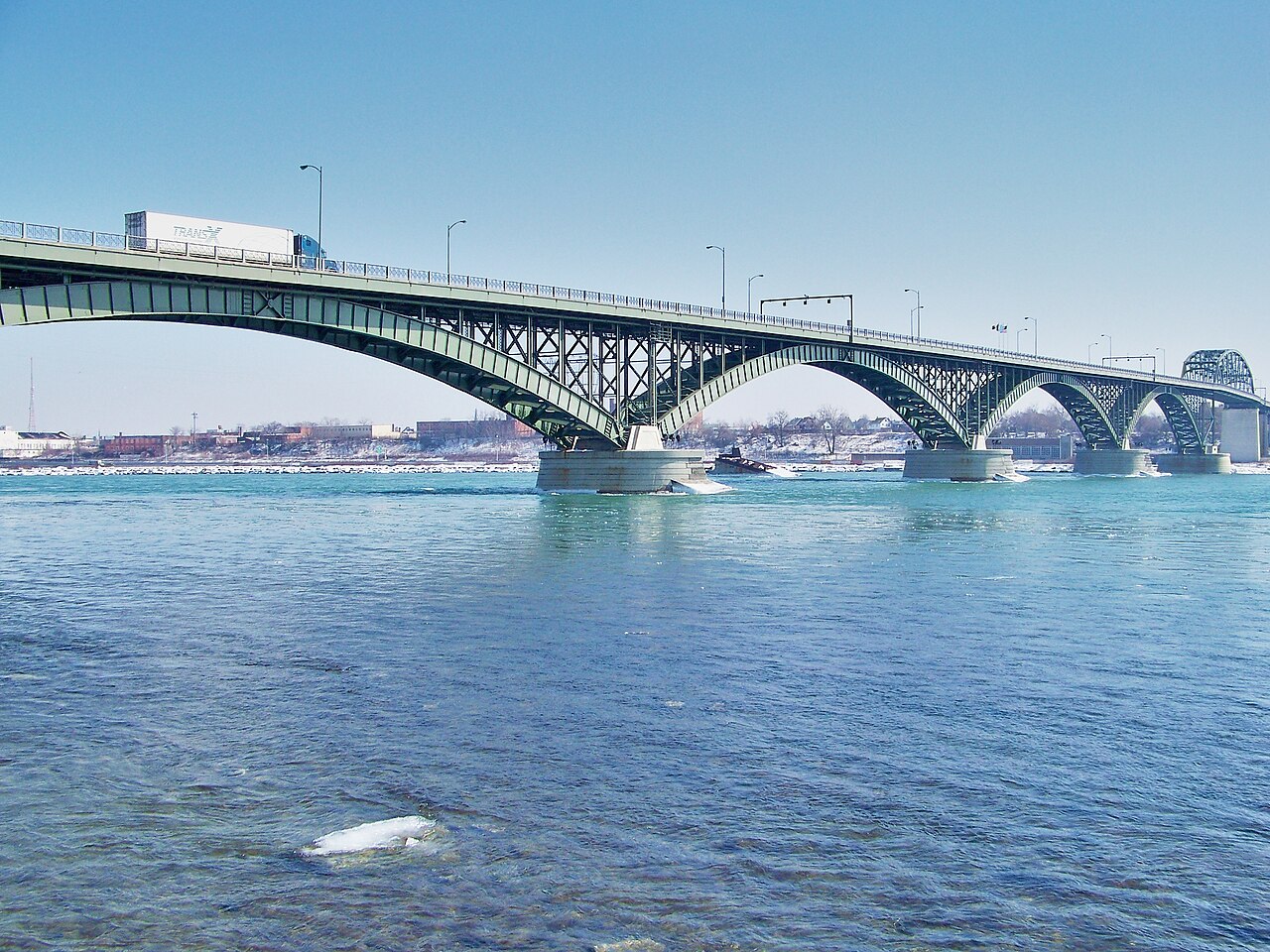
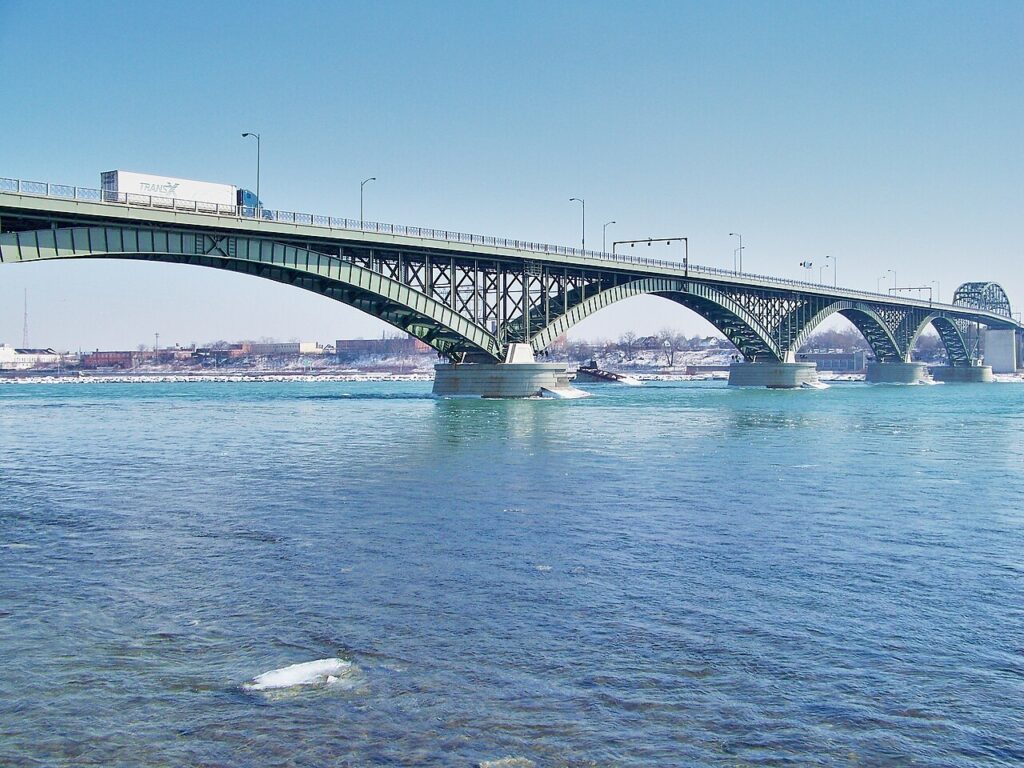
| Peace Bridge | Buffalo, NY ↔ Fort Erie, ON | Cars, commercial trucks, cyclists and pedestrians | The main truck/commercial route and the I-190 connection to Buffalo |
A few practical points. The Rainbow Bridge is open 24/7 and sits right beside the Falls, so it is the natural choice for tourists – and the only one you can cross on foot. The Whirlpool Rapids Bridge is restricted to NEXUS members (Global Entry is accepted for US-bound travel), keeps shorter hours, and has been subject to temporary construction closures – check the NFBC’s status page before you rely on it. The Lewiston-Queenston Bridge is the one to use if you are heading to or from the wider region and want to skip the downtown crush. The Peace Bridge at Fort Erie is the southernmost, carries the heavy commercial traffic, and is now a completely cashless facility.
Crossing on foot: the Rainbow Bridge pedestrian toll
Walking across the border at Niagara is one of the genuinely memorable things to do here – a dedicated walkway on the Rainbow Bridge gives you a mid-gorge view over the river. Remember that the Rainbow Bridge is the only Niagara Falls crossing that pedestrians may use; you cannot walk across the Whirlpool or Lewiston-Queenston bridges. (Pedestrians and cyclists may also cross the Peace Bridge at Fort Erie, several kilometres south.)
The pedestrian toll on the Rainbow Bridge, verified on the NFBC’s official pedestrian page on 24 July 2026, is:
- US$1.00 (US quarters, exact change), or
- CAD$1.25 (Canadian loonies and quarters, exact change), or
- CAD$1.25 by tap – Visa, Mastercard, debit or Apple Pay, charged in Canadian currency
Here is the wrinkle worth knowing: the pedestrian toll is collected going into the United States only, at the turnstile before you step onto the walkway. Walking into Canada is effectively free at the turnstile – you pay on the return leg into the US. Change machines are available for both currencies if you arrive without coins. For more on the on-foot experience and current conditions, see our Rainbow Bridge guide.
Driving across: vehicle tolls
On the three NFBC bridges (Rainbow, Whirlpool and Lewiston-Queenston), the passenger-vehicle toll is US$6.00 or CAD$8.50, effective 1 May 2025, and – unlike the pedestrian toll – it is collected one way, going into Canada; the return into the US is free. Payment is by cash, E-ZPass, ExpressPass or NEXUS.
The Peace Bridge is cashless and priced differently: a passenger vehicle pays roughly US$4.00 with an E-ZPass, versus about US$8.00 by card or the Canadian-dollar equivalent (around CAD$10.75). Pedestrians and cyclists cross the Peace Bridge toll-free. These vehicle figures come partly from secondary sources; confirm current amounts on peacebridge.com and niagarafallsbridges.com before you rely on them, as tolls were raised in 2025.
Check live border wait times before you leave
Wait times at the Niagara crossings swing wildly – a bridge that is empty at 9am on a weekday can back up badly on a summer Sunday afternoon or a fireworks night. The good news is that CBP publishes official, real-time wait times for every Niagara-area crossing at bwt.cbp.gov, broken out by passenger vehicle, pedestrian and commercial traffic, and showing lanes open and NEXUS/Ready Lane times. It is the authoritative source, and it is worth a look before you decide which bridge to use and when to go.
For a local, plain-language read on what conditions are like right now – alongside the border wait times – see our live Niagara Falls conditions page. Checking wait times and picking an off-peak hour is the single easiest way to make your crossing painless. As a rule of thumb, early mornings and late evenings are quieter than midday, and weekdays beat weekends.
Duty-free basics
If you shop across the border, personal exemptions depend mainly on how long you were away. The figures below are the commonly cited allowances and are a useful rough guide, but they shift – confirm the current numbers with CBSA (“I Declare”) and CBP before you count on them.
- Returning to Canada (residents): no exemption for trips under 24 hours; roughly CAD$200 after 24 hours; roughly CAD$800 after 48 hours. Alcohol and tobacco allowances apply only at the 48-hour level, and you must meet the province’s legal age.
- Returning to the US (residents): roughly US$200 for trips under 48 hours; roughly US$800 after 48 hours, with separate alcohol and tobacco limits.
Duty-free shops sit at the land crossings, but goods bought there are for export – you may still owe duty when you import them into the destination country if you are over your allowance. Declare everything honestly; it is faster and cheaper than being found out.
A quick planning checklist
- Carry a passport book if there is any chance you will fly at any point in the trip.
- US/Canadian citizens 16+ crossing only by land: passport book, passport card, EDL or NEXUS all work.
- Bringing children: birth certificate is accepted by land, but a passport is smoother – and bring a consent letter if a child travels without both parents.
- VWP national (UK, EU, Japan, Australia, etc.): apply for your ESTA at esta.cbp.dhs.gov before you leave – it is required even by land, and can take up to 72 hours.
- You do not need ArriveCAN for a land crossing.
- Check bwt.cbp.gov for live wait times and cross off-peak.
- On foot? Only the Rainbow Bridge works – bring US$1.00 in quarters or tap CAD$1.25, collected going into the US.
Important: these rules change – confirm officially before you travel
Everything in this guide was verified against official government and bridge-operator sources on 24 July 2026. Entry requirements, fees, tolls and duty-free limits are exactly the kind of facts that change without much notice – the ESTA fee alone has moved twice recently, and the NFBC raised its tolls in 2025. Treat this article as a well-researched starting point, not as the final word, and always reconfirm the specifics that matter to your trip against the primary sources before you leave.
- Entering the US / ESTA / WHTI documents: US Customs and Border Protection (cbp.gov), the Department of Homeland Security (dhs.gov), and travel.state.gov for passports.
- Entering Canada / documents / duty-free: the Canada Border Services Agency (cbsa-asfc.gc.ca), Immigration Refugees and Citizenship Canada, and travel.gc.ca.
- Live wait times: bwt.cbp.gov.
- Tolls and which bridge to take: niagarafallsbridges.com (Rainbow, Whirlpool, Lewiston-Queenston) and peacebridge.com (Peace Bridge).
Get your documents sorted a few weeks ahead, apply for any ESTA early, check the live wait times on the day, and your Niagara border crossing should be one of the easiest parts of the trip – leaving you free to enjoy the Falls on both sides.
Frequently asked questions
Do you need a passport to visit Niagara Falls?
If you are staying entirely on one side of the border, no – Niagara Falls has attractions in both New York and Ontario, and you only cross the border if you want to visit the other country. But to cross at Niagara you need a passport or an approved equivalent. For US and Canadian citizens aged 16 and over crossing by land, a passport book, passport card, Enhanced Driver's Licence or NEXUS card all work. A passport book is the safest choice because it also works if you fly.
Can I cross the Niagara border with just a driver's licence?
An ordinary driver's licence is not enough – it proves identity but not citizenship. You need a document that proves both, such as a passport, passport card, NEXUS card, or an Enhanced Driver's Licence (an EDL is a special licence marked with a US flag and the word Enhanced, issued by only five US states: Michigan, Minnesota, New York, Vermont and Washington). A standard licence plus a birth certificate may be accepted, but a passport is far smoother.
Do children need a passport to cross the border at Niagara Falls?
US and Canadian citizen children under 16 can cross by land with proof of citizenship, such as a birth certificate, rather than a passport. A passport is still recommended and is required if the child flies. If a child travels without both parents or guardians, carry a notarized consent letter from the non-accompanying parent, as border officers may ask for it.
Do UK or European visitors need an ESTA to cross into the US at Niagara by land?
Yes. Since 1 October 2022, all Visa Waiver Program travellers – including UK, most EU, Japanese and Australian nationals – must hold an approved ESTA before entering the US even at a land crossing, not just by air. Apply in advance at the official site esta.cbp.dhs.gov, as approval can take up to 72 hours. This is one of the most common misunderstandings at the Niagara bridges.
Is ArriveCAN still required to enter Canada in 2026?
No. ArriveCAN has not been mandatory since 1 October 2022. What remains is an optional Advance Declaration feature for air travellers to submit their customs declaration before landing at participating Canadian airports. You do not need ArriveCAN to drive or walk across the border at Niagara.
How much is the toll to walk across the Rainbow Bridge?
The pedestrian toll on the Rainbow Bridge is US$1.00 in US quarters, or CAD$1.25 in Canadian coins, or CAD$1.25 by tap card or Apple Pay. It is collected only when going into the United States, at the turnstile before the walkway; walking into Canada is effectively free at the turnstile. The Rainbow Bridge is the only Niagara Falls crossing pedestrians may use.
Which Niagara bridge should I use?
For tourists, the Rainbow Bridge is closest to the Falls and is the only one you can walk across. NEXUS members can use the Whirlpool Rapids Bridge (NEXUS-only, and subject to construction closures). The Lewiston-Queenston Bridge is good for through-traffic and avoiding downtown congestion. The Peace Bridge at Fort Erie is the main commercial route and connects to I-190 for Buffalo. Check live wait times at bwt.cbp.gov before choosing.
Can I fly home with just a passport card or Enhanced Driver's Licence?
No. The passport card and Enhanced Driver's Licence are valid only for land and sea crossings, not for international air travel. If there is any chance your trip could end with you flying back into the United States – a change of plans or a weather diversion – carry a passport book. This is the most common trap for cross-border travellers at Niagara.
Crossing for the day? Our complete guide to things to do in Niagara Falls labels which side of the border each attraction is on, so you can plan around a single crossing.
Coming from Toronto, see our Niagara Falls day trip from Toronto guide for whether a two-country day is realistic in the time you have.