
Last updated: July 2026
Niagara Falls is about 12,000 years old — young, by waterfall standards. It formed at the end of the last ice age, when glacial meltwater from the newly created Great Lakes began pouring over the edge of the Niagara Escarpment near today’s Queenston, Ontario and Lewiston, New York. Since then the falls have chewed their way roughly 11 kilometres (7 miles) upstream to their current position — and they’re still moving. The rock the water pours over, though, is far older: 400 to 440 million years, laid down as sediment in a tropical sea long before dinosaurs existed.
The short version of a 12,000-year story
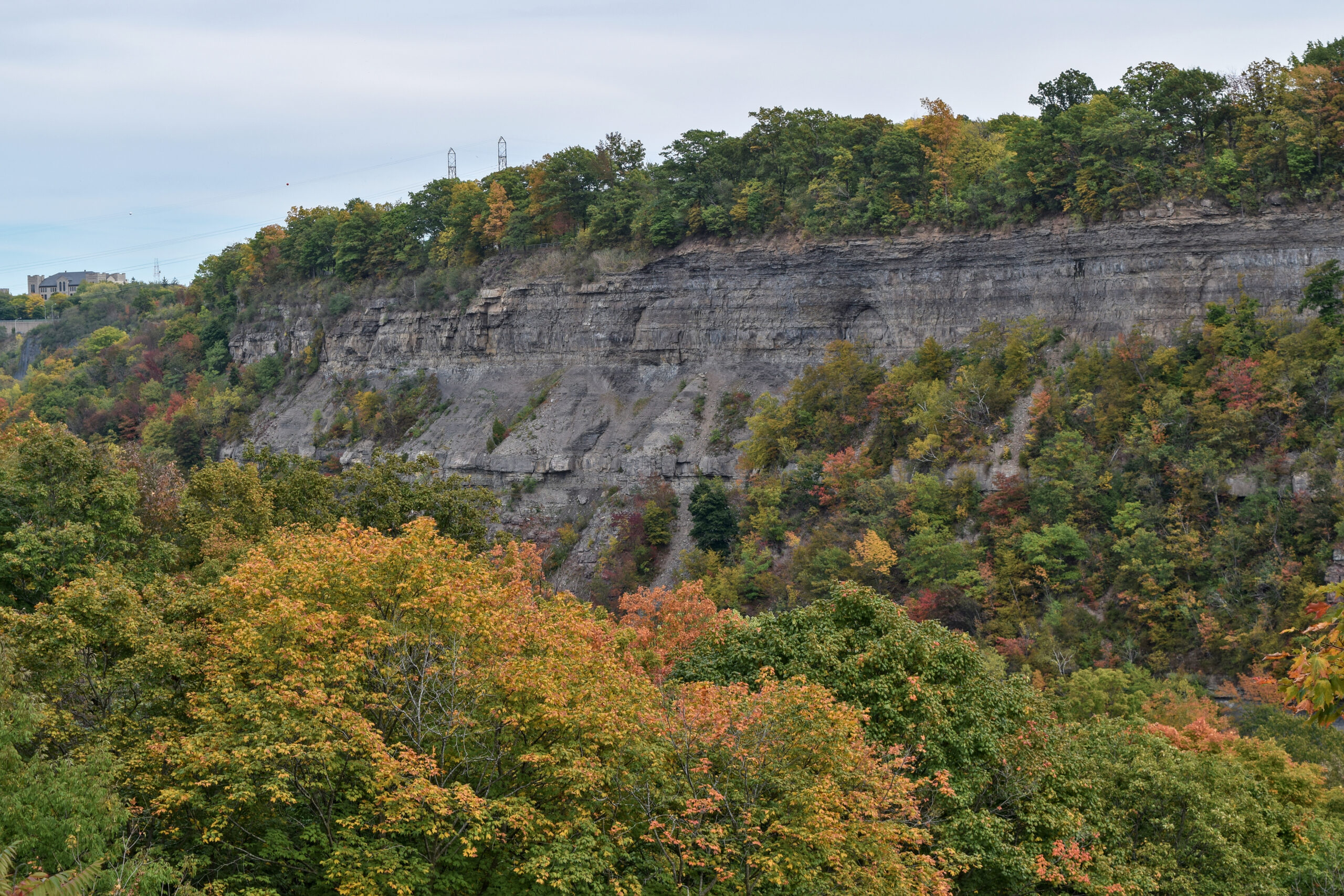
When the ice sheets of the last glaciation retreated from the Niagara Peninsula — the land became ice-free roughly 12,500 years ago — meltwater filled the basins that became the Great Lakes. Water from Lake Erie found a low route north to Lake Ontario, spilling over the Niagara Escarpment: a long ridge of hard rock running across the region (the same ridge Hamilton’s “mountain” and parts of the Bruce Trail sit on).
That first waterfall stood at the escarpment’s edge, near the Queenston–Lewiston bridge. Ever since, the falls have been eating backward — upstream, toward Lake Erie — leaving behind the deep trench you see today: the Niagara Gorge. The gorge is, in effect, the falls’ 11-kilometre-long fossil trail. Flow through the current channel reached full power around 5,500 years ago, after earlier meltwater rerouting upstream settled into today’s configuration.
Why the falls erode: a hard cap on a soft base
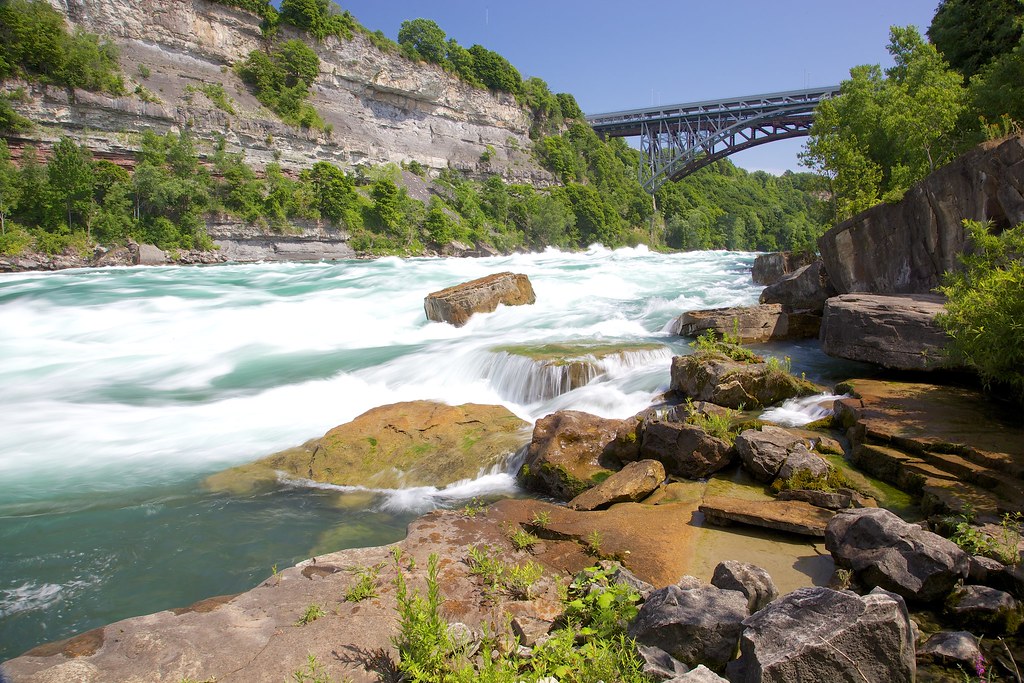
The Niagara River pours over a lid of Lockport dolostone — a hard, erosion-resistant limestone-family rock. Beneath it sit much softer shales and sandstones. The plunging water and its spray constantly wear away those soft lower layers, undercutting the hard cap until an unsupported shelf of dolostone snaps off under its own weight. Rockfall by rockfall, the brink steps backward. That undercutting is also what created the overhang behind the water curtain — the space that Journey Behind the Falls tunnels into.
You can read the whole rock sandwich in the gorge walls at Niagara Glen, where 400-plus million years of seabed sit stacked like pages.
How fast is Niagara Falls eroding?
Slower than it used to — because of us. Before the mid-20th century, the Horseshoe Falls retreated about 3 to 5 feet (1 to 1.5 m) per year. Today, Niagara Parks puts the rate at roughly 1 foot (30 cm) per year, possibly as little as 1 foot per decade. Two reasons:
- Half the water is missing. Under the 1950 Niagara Diversion Treaty, Canada and the US divert more than half the river’s flow to hydroelectric stations. The treaty guarantees 2,832 cubic metres per second (100,000 cubic feet) over the falls during daytime tourist hours in summer, and 1,416 m³/s (50,000 cfs) at night and in the off-season. Less water, less erosive force.
- Engineering. Flow-control structures upstream spread the river more evenly across the Horseshoe crest, and past remedial work reinforced weak points — deliberately slowing the retreat.
The year the American Falls was turned off
In June 1969, the US Army Corps of Engineers did something that still sounds impossible: they dammed the American Falls dry. For nearly six months, tourists stared at a bare cliff while engineers studied the enormous boulder pile (talus) at its base and debated removing it to “improve” the view. The verdict, delivered before the cofferdam came out in November 1969: leave nature alone. The talus stayed, and the American Falls has tumbled over its own rubble ever since. (The falls also stopped once by accident — the great ice jam of 1848, the only natural stoppage on record.)
Niagara Falls by the numbers
| Fact | Figure |
|---|---|
| Age of the falls | ~12,000 years (region ice-free ~12,500 years ago) |
| Age of the bedrock | 400–440 million years |
| Distance retreated | ~11 km (7 miles) from Queenston–Lewiston |
| Horseshoe Falls height | 57 m (188 ft) |
| Horseshoe Falls crest width | ~670 m (2,200 ft) |
| American Falls height | 21–34 m (70–110 ft), landing on talus |
| American Falls crest width | ~260 m (850 ft) |
| Summer daytime flow over the falls | 2,832 m³/s (100,000 cfs) minimum |
| Night/off-season flow | 1,416 m³/s (50,000 cfs) |
| Share of flow diverted to hydro | Over half, varying by time of day and season |
| Current erosion rate | ~30 cm/year or less (down from ~1–1.5 m/year historically) |
| Number of waterfalls | Three: Horseshoe, American, Bridal Veil |
Figures from Niagara Parks’ official geology facts, current as of July 2026.
Where is Niagara Falls going next?
Upstream, slowly. At current rates, the Horseshoe Falls’ long-term future is a slow march toward Lake Erie, about 32 km (20 miles) away — a journey projected to take on the order of 50,000 years. The American Falls faces a different fate: it sits on a side channel with only about 7% of the river’s flow, too little to keep pace, and Niagara Parks notes it could effectively dry up within roughly 2,000 years as its channel is abandoned. Nothing about the falls is permanent — which is either sobering or a good reason to see it this year, depending on your temperament.
For the human side of this story — the daredevils, the power stations, the parks movement that saved the brink from mills — start with our guide to the history and ecology of the Niagara River and the Niagara power station story.
Frequently asked questions
How old is Niagara Falls exactly?
About 12,000 years. The Niagara region emerged from the last ice age roughly 12,500 years ago, and the falls formed shortly after as Great Lakes meltwater began spilling over the Niagara Escarpment.
Is Niagara Falls the oldest waterfall in the world?
No — it’s geologically young. Many of the world’s great waterfalls sit on rock formations vastly older. Niagara’s fame comes from its volume: it moves more water than any other waterfall in North America.
How was Niagara Falls formed?
By glacial meltwater. As the last ice age ended, water from the young Great Lakes carved a path from Lake Erie to Lake Ontario over the Niagara Escarpment. The waterfall that formed at the escarpment edge has been eroding upstream ever since, cutting the Niagara Gorge behind it.
Is Niagara Falls shrinking or moving?
It’s moving — retreating upstream about 30 centimetres a year or less, down from roughly a metre a year before hydroelectric diversion halved the flow. The height stays roughly constant; it’s the position that changes.
Will Niagara Falls ever disappear?
Eventually, on geological timescales. Projections suggest the falls could reach Lake Erie in about 50,000 years, at which point the escarpment waterfall as we know it would cease to exist. No one reading this needs to hurry.
Why is Niagara Falls so powerful?
It drains four of the five Great Lakes — about a fifth of the world’s fresh surface water funnels through the Niagara River. Even with more than half the flow diverted for electricity, 2,800+ cubic metres per second go over the brink on a summer afternoon.