
Last updated: July 2026
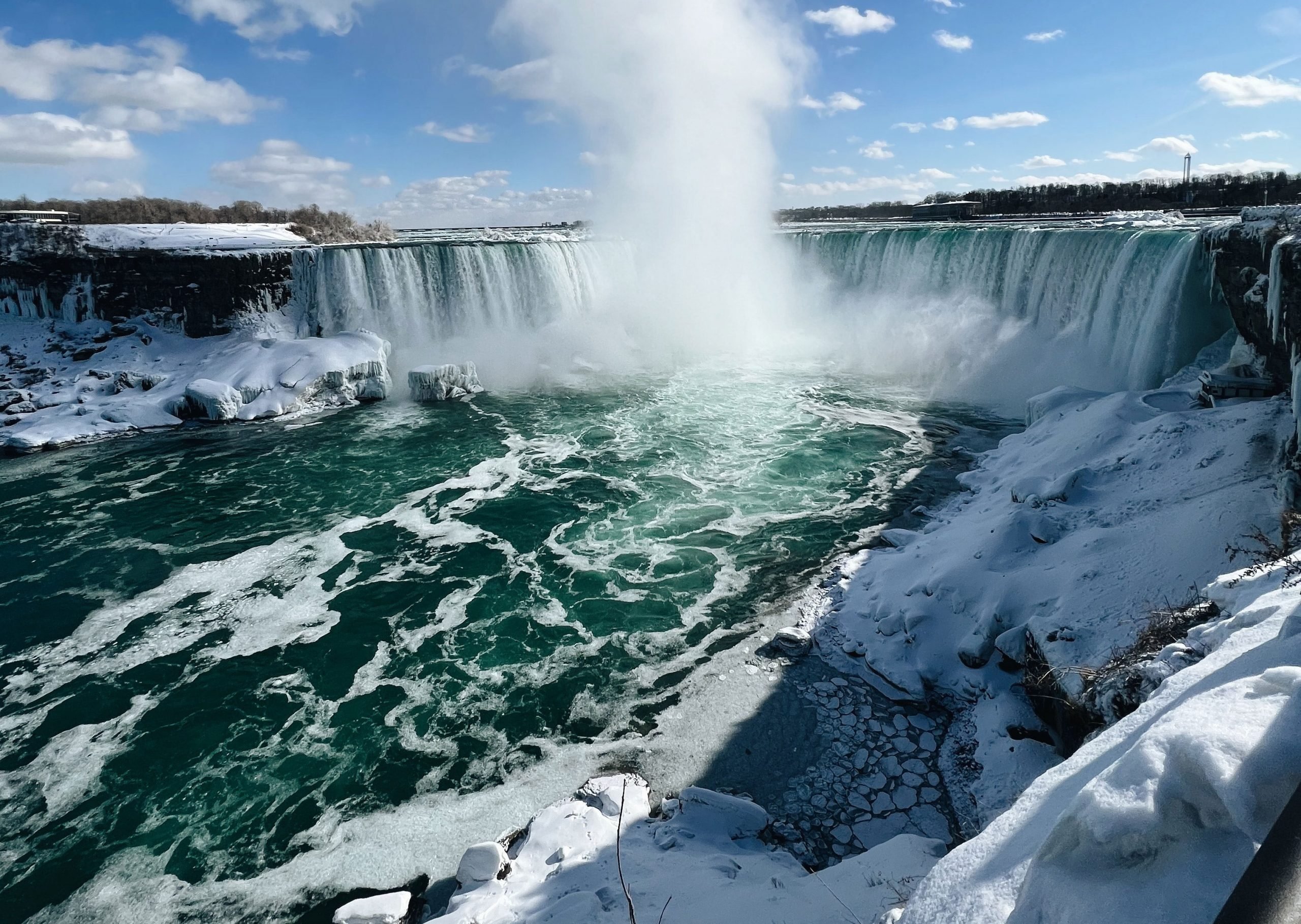
No — Niagara Falls has never completely frozen, and it can’t. Even in the coldest winters, at least 1,400 cubic metres of water per second keep pouring over the edge, and moving water that heavy doesn’t freeze solid. What does happen is arguably better to look at: the mist freezes onto every rock, rail and tree, ice sheets called the “ice bridge” pile up in the basin below, and the American Falls — whose flow spreads thinnest of the three — can appear frozen almost solid in a hard cold snap. The river stopped flowing exactly once in recorded history, in March 1848, and it wasn’t because of freezing at the falls at all.
What those viral “frozen Niagara” photos actually show
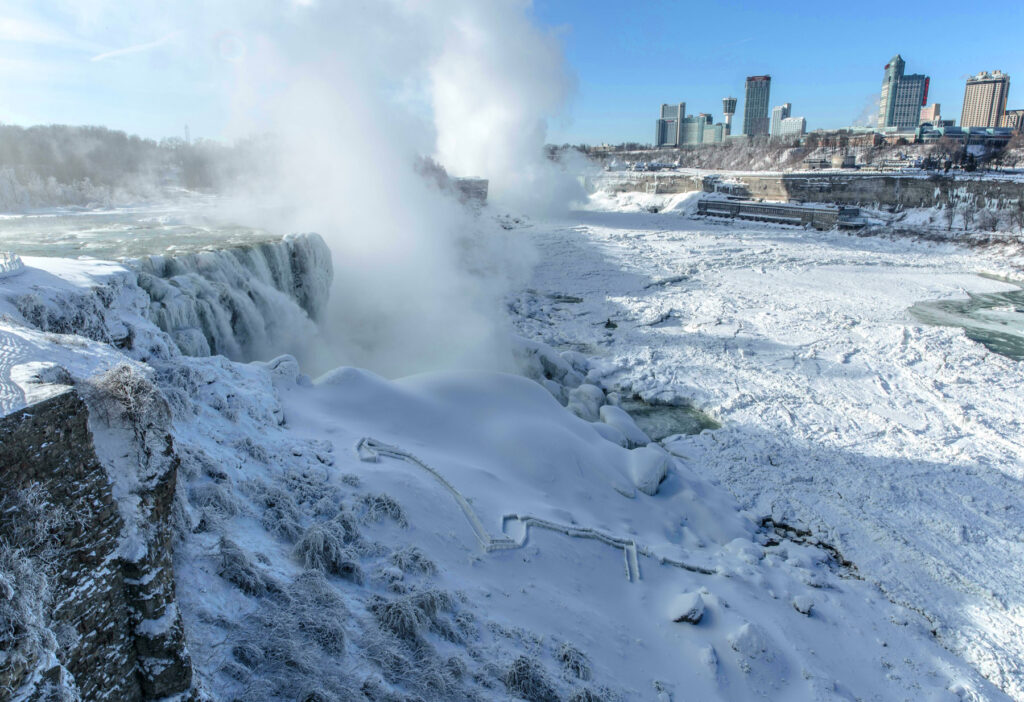
Every few winters — most famously during the polar-vortex cold of 2014, 2015 and 2019 — photos of a “frozen Niagara Falls” go viral. They’re real photos, but the falls aren’t frozen. What you’re seeing:
- Frozen mist. The spray cloud coats everything near the falls in layers of white rime, so the whole scene reads as solid ice.
- The ice bridge. Ice floes from Lake Erie and frozen spray accumulate in the pool below the falls, sometimes 10 metres thick or more, bank to bank.
- An icy face on the American Falls. Its flow is a fraction of the Horseshoe’s, spread thin over talus boulders, so ice columns can build across much of its face while water keeps running underneath and behind.
Behind all that ice, the Horseshoe Falls thunders on. In winter roughly 1,416 cubic metres per second (50,000 cubic feet) still go over — the treaty minimum for the off-season — which is why the “frozen falls” always have a live green-white core.
The one time Niagara Falls actually stopped: March 1848
On the night of March 29, 1848, the falls fell silent. High winds had driven the breaking Lake Erie ice pack into the mouth of the Niagara River at Buffalo, jamming it into a natural dam. For roughly 30 hours the riverbed lay nearly dry. Thousands walked out to pick up bayonets and tomahawks left from the War of 1812; mill owners panicked; some residents took the silence for the end of the world and headed to church. Then the jam gave way and the river returned in a wall of water.
It has never happened again, and modern engineering makes a repeat very unlikely — which brings us to a structure most visitors have never heard of.
The ice boom: why 1848 won’t repeat
Every December since 1964, a 2.7-kilometre chain of steel pontoons — the Lake Erie–Niagara River ice boom — is installed where the lake empties into the river. It encourages a stable ice arch to form on the lake side and stops large ice runs from surging downstream, protecting hydro intakes and shoreline. It’s typically installed in mid-December and removed in early April. So if you’re hoping to witness the falls run dry: the ice boom, and the sheer volume of the Great Lakes behind it, say no.
The ice bridge — and why you can’t walk on it anymore
For decades, the winter ice bridge below the falls was the attraction: vendors set up shanties selling liquor and souvenirs, and thousands strolled between the two countries on the frozen basin. That era ended on February 4, 1912, when the ice broke loose with dozens of people on it. Three died — a couple swept away together, and 17-year-old Burrell Hecock, who let go of a rescue rope to run back and help them. Walking on the ice bridge has been forbidden ever since. Today you admire it from the rails — the ice heaves and groans below Table Rock and Prospect Point all winter.
Is winter a good time to visit? Honestly, yes

Winter is the falls’ underrated season, provided you dress for it. What you get from December through February:
- The ice spectacle. Rime-coated trees, frozen mist sculptures on every lamppost, and the ice bridge below. After a cold snap it looks like a different planet.
- Nightly illumination, earlier. The falls are lit every night of the year; in November–December 2026 the lights come on at 4:30 p.m., so you can see the show before dinner.
- Winter Festival of Lights. Three million lights along the parkway and Dufferin Islands, free, from November 14, 2026 to January 10, 2027.
- No crowds and the year’s lowest hotel prices. January and February are the quietest months on both sides — more in our month-by-month guide.
What’s open (and closed) at the falls in winter
| Experience | Winter status |
|---|---|
| Viewing the falls (both sides) | Open — parks never close |
| Illumination | Every night, year-round |
| Journey Behind the Falls (ON) | Open year-round (lower outdoor deck closed in winter) |
| Maid of the Mist / Niagara City Cruises | Closed — boats run roughly late April/May to early November (2026: Maid of the Mist ends Nov 9) |
| Cave of the Winds (NY) | Winter “gorge trip” only — the wooden decks are dismantled every fall and rebuilt in spring |
| Skylon Tower, casinos, museums, indoor attractions | Open |
| Fireworks series | Seasonal (mid-May to mid-October, plus select holiday dates) |
The boats are the big winter absence. If a boat ride is the point of your trip, visit between May and October — details in our boat tour comparison.
What to wear
The falls make their own weather: the mist that paints the ice also lands on walkways and glasses. Near the rails you want waterproof outer layers, insulated boots with real tread (paths can be glazed), a hat that covers your ears, and gloves you can operate a camera in. Average January temperatures run about −6°C to −1°C (21–30°F), and the wind off the gorge makes it feel colder. Our winter visit guide has a fuller packing list.
Frequently asked questions
Has Niagara Falls ever frozen completely?
No. The falls themselves have never frozen solid. The only recorded stoppage was March 29–30, 1848, when an ice jam at the river’s source at Lake Erie dammed the flow for about 30 hours — the riverbed emptied, but nothing froze in place.
Why can’t Niagara Falls freeze?
Volume and motion. Even at the winter treaty minimum, about 1,400 cubic metres of water per second pass over the falls, constantly churning. Surface ice and frozen spray build up around the edges, but the moving core never gets cold enough, long enough, to solidify.
When can I see the “frozen” falls?
After a sustained cold snap, usually mid-January through February. The longer the deep freeze, the thicker the ice bridge and the icier the American Falls face. There’s no guarantee — some mild winters produce little ice at all.
What is the ice bridge at Niagara Falls?
The sheet of piled ice that forms across the river basin below the falls in cold winters, built from Lake Erie floes and frozen mist. People walked — and partied — on it until the tragedy of February 4, 1912, when it broke apart and three people died. Walking on it has been banned ever since.
Is Niagara Falls worth visiting in winter?
If you dress for the cold, yes — ice scenery, the nightly illumination from 4:30 p.m., the free Winter Festival of Lights (Nov 14, 2026–Jan 10, 2027), the smallest crowds and the cheapest hotel rates of the year. Just know the boats don’t run.
Does the Maid of the Mist run in winter?
No. The boats on both sides stop in early November and return in late April or May. Journey Behind the Falls on the Canadian side is the closest year-round substitute.