
The Maid of the Mist: A Detailed Historical Account
Introduction
The Maid of the Mist has carried passengers to the foot of Niagara Falls since 1846, making it one of North America’s oldest continuously operating tourist attractions. What started as a humble steam ferry shuttling people and cargo across the lower river grew into the iconic boat tour that still noses into the spray of the Horseshoe Falls today. This is the story of how it evolved alongside Niagara Falls itself.
Early Beginnings
The Maid of the Mist traces its origins to 1846, when Niagara Falls was fast becoming one of the continent’s most celebrated destinations. The first vessel to carry the name launched that year as a steam-powered ferry, shuttling passengers, cargo, and mail across the lower Niagara River for a small fare.
When a suspension bridge opened nearby in 1848, ferry traffic dropped sharply. Rather than retire the boat, its operators reinvented the crossing as a sightseeing trip, steering closer to the falls so passengers could feel the mist and thunder firsthand, and a lasting tourist attraction was born.
Native American Legend
The name itself comes from a well-known legend tied to the falls. As the story is told, Lelawala, a young woman of the Ongiara people, gave her life to the waters of the Horseshoe Falls to appease the Thunder God and protect her people from harm.
In honour of her courage, the legend holds that she became the spirit of the falls, living on within the rising mist. That image, a maiden dwelling in the spray, is said to have inspired the boat’s enduring name.
Development and Expansion
Through the late 19th century, the Maid of the Mist grew steadily in popularity, and its early boats were replaced by larger vessels to keep pace with rising demand. In 1884 the tour was reorganized under the Maid of the Mist Corporation, the operating name that endures today.
Reaching the docks at the bottom of the gorge was its own challenge. From 1894, an inclined funicular railway carried visitors down to the Canadian landing; it ran until 1990 and was replaced by elevators the following year.
20th Century Revamp
Through the 20th century the fleet was modernized again and again. Wooden steamers gave way to steel-hulled, diesel-powered boats with covered decks and greater capacity, improving both safety and comfort as annual visitor numbers climbed into the millions.
For decades, near-identical operations ran from both the American and Canadian shores, giving travellers two vantage points on the same voyage into the basin below the falls.
Modern Era and Sustainability
The most significant recent change came in 2013, when the Maid of the Mist’s Canadian licence ended. Since 2014 the tour has departed solely from the American side, within Niagara Falls State Park, while a separate operator now runs the cruises across the river in Canada.
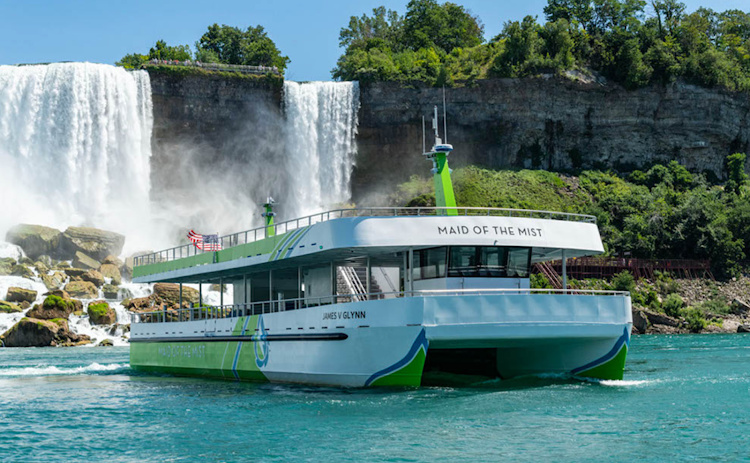
Sustainability has shaped the fleet’s latest chapter. In 2020 the company launched two all-electric vessels, the James V. Glynn and the Nikola Tesla, among the first passenger boats of their kind built in the United States. Running on lithium-ion battery packs, they produce no onboard emissions as they approach the falls.
Reception and Recognition
Over the years, the Maid of the Mist has become one of the most recognizable symbols of Niagara Falls, appearing in countless films, photographs, and travel accounts. Passengers step aboard in the tour’s signature ponchos for a close encounter with the sheer force of the water, a scene that has come to represent the falls themselves.
Conclusion
Today the Maid of the Mist runs seasonally, generally from spring through late autumn and weather permitting. Nearly 180 years after its first crossing, it remains one of the most direct ways to stand within arm’s reach of Niagara Falls, close enough to feel the mist that gave the boat its name.
Weighing your options? See our side-by-side guide to Niagara City Cruises vs the Maid of the Mist.